![]() |
![]() |
![]() |
![]() |
| EVOLUTION | MATTER & ENERGY | INFORMATION | INTERACTIONS |
|
|
| MONDAY 1/21 | TUESDAY 1/22 | WEDNESDAY 1/23 | THURSDAY 1/24 | FRIDAY 1/25 | ||
|
NO SCHOOL simulation from Concord Consortium's Molecular Workbench |
Digestive system DUE Science News Bright spot in ND Study Log Start Fast Plants Revisit Semester test HW: 1. Review DNA essays. You will write one of these in class tomorrow. I get to pick. 2. Start "Reading for understanding" Chapter 8, 9, 10 3.REVIEW your "BIO" brain for Chap 9 & 10 4. DNA test corrections due by end of day THURS 1/31 5. Finish GREEN "To Do List" from Lab day by FRI 2/8 |
Write DNA essay in class HW: 1. Go to Biology Place Lab Bench View Lab 2 tutorial and activities 2.Work on prelab ?'s due MONDAY 3.DNA test corrections due by end of day THURS 1/31 4. Finish GREEN "To Do List" from LAB DAY by FRI 2/8 |
Chapter 8 1. Go to Biology Place Lab Bench View Lab 2 tutorial and activities 2.Work on prelab ?'s due MONDAY 3.Take Google docs Enzymes quiz by MON 4.DNA test corrections due by end of day THURS 1/31 5. Finish GREEN "To Do List" from LAB DAY by FRI 2/8 |
Opener Chainobead polymerase activity from Paula Petterson ?'s due FRI 2/8HW: 1. Go to Biology Place Lab Bench View Lab 2 tutorial and activities 2.Work on prelab ?'s due MONDAY 3.Take Google docs Enzymes quiz by MON 4.DNA test corrections due by end of day THURS 1/31 5. Finish GREEN "To Do List" from LAB DAY by FRI 2/8 |
||
| MONDAY 1/28 | TUESDAY 1/29 | WEDNESDAY 1/30 | THURSDAY 1/31 | FRIDAY 2/1 | ||
Opener You should have taken the Google docs Enzymes quiz by today Catalase Prelab ?'s due Catalase lab HW: 1.DNA test corrections due by end of day THURS 2. Watch "Draw Photosynthesis" video and fill in your DIAGRAM showing the steps by Finish GREEN "To Do List" from LAB DAY by FRI 2/8 |
Enzyme opener Catalase lab "old lab 2"
HW: |
Photosynthesis
Chemiosmosis |
![]() NO SCHOOL Watch "Draw Photosynthesis" video and fill in your DIAGRAM m showing the steps by today Take the Google docs Photosynthesis quiz by tomorrow Test corrections due by end of school today
|
Take the Google
docs
Photosynthesis quiz by
today SUB HERE Gone to One Act Play Work on
TO DO LIST
GREEN "To Do List" from LAB DAY
Chainobead polymerase activity from Paula Petterson
HW: |
||
| MONDAY 2/4 | TUESDAY 2/5 | WEDNESDAY 2/6 | THURSDAY 2/7 | FRIDAY 2/8 | ||
|
C4 & CAM photosynthesis comparison Photosynthesis on hot/dry days Photosynthesis Venn HW: 1. Photosynthesis Venn due TOMORROW 2. Take the Google docs Cell Respiration quiz by THURS 4. Finish Lab notebooks by MON |
Photosynthesis venn due Opener Respiration Watch Bozeman video Slide show notes Photosynthesis theater Glycolysis animation Krebs cycle animation ETC-NADH ETC-FADH2 Glycolysis ETC
HW: |
Opener Card Review ANSWERS Card review with answers HW: 1. Mitochondria/Chloroplast Venn DUE tomorrow 2. Take the Google docs Cellular Respiration quiz by TOMORROW 3. Finish lab notebooks by MON 4. Study for TEST MON |
Take the Google docs Cellular Respiration quiz by TODAY Mitochondria/Chloroplast Venn due Check Venn answers
Clicker
game ?'s |
SUB HERE See "To do" list 3 Google docs quizzes Enzymes quiz Photosynthesis quiz Cellular Respiration quiz Finish lab notebooks due MON Card review w/answers at end Study for test MONDAY Google docs ANSWERS Enzymes Photosynthesis Respiration HW: 1.Study for Chapter 8, 9, 10 test MONDAY 2.Lab notebooks due MONDAY |
||
| MONDAY 2/11 | TUESDAY 2/12 | WEDNESDAY 2/13 | THURSDAY 2/14 | FRIDAY 2/15 | ||
![]() SNOW DAY! Google docs ANSWERS Enzymes Photosynthesis Respiration |
TURN IN LAB NOTEBOOK TEST-Chap 8,9,&10 Enzymes, Respiration & Photosynthesis |
|
|
|||
| MONDAY 2/18 | TUESDAY 2/19 | WEDNESDAY 2/20 | THURSDAY 2/21 | FRIDAY 2/22 | ||
|
NO
SCHOOL |
Endocrine system due | |||||
| MONDAY 2/25 | TUESDAY 2/26 | WEDNESDAY 2/27 | THURSDAY 2/28 | FRIDAY 2/29 | ||
|
|
||||||
| MONDAY 1/9 | TUESDAY 1/10 | WEDNESDAY 1/11 | THURSDAY 1/12 | FRIDAY 1/13 | ||
|
|
|
|
||||
12/11/2011
Death of
Lynn Margulis
| Bozeman Biology | |||||||
| Enzymes | Cellular Respiration |
Biology Essentials Photosynthesis & Respiration |
Photosynthesis 4/3/12 |
Postive/Negative Feedback loops | Gibbs Free Energy |
Coupled Reactions 5/9/12 |
|
|
LAB 2 Enzyme Catalysis |
Photosynthesis Lab Walk through |
LAB 4 Photosynthesis |
Respiration Lab Walk through |
Lab 5 Cellular Respiration |
Bioenergetics posted 4/3/12 |
||
| KHAN ACADEMY | |||||||
|
Redox Review |
Redox in Cells |
Cellular Respiration |
ATP |
Glycolysis |
|||
| OTHER YOUTUBE VIDEOS | |||||||
|
Mr. Hsu Cellular Respiration |
Glucose Song | Photosynthesis Song |
Photosynthesis Rap | Cellular Respiration |
David Knuffke's Prezis
| Metabolism 1: Cellular Energetics |
Metabolism 2: Chemoheterotrophic Nutrition |
Metabolism 3: Photoautotrophic Nutrition |
|
| Videos
from: KHAN ACADEMY PHOTOSYNTHESIS OVERVIEW PHOTOSYNTHESIS LIGHT REACTIONS 1 PHOTOSYNTHESIS LIGHT REACTIONS & PHOTOPHOSPHORYLATION PHOTOSYNTHESIS CALVIN CYCLE PHOTORESPIRATION C4 PHOTOSYNTHESIS CAM Redox reactions REDOX in CELLULAR RESPIRATION INTRO TO CELLULAR RESPIRATION ELECTRON TRANSPORT CHAIN OXIDATIVE PHOSPHORYLATION & CHEMIOSMOSIS ATP University of California College prep AP BIOLOGY http://www.ucopenaccess.org/course/view.php?id=8 You
tube videos
Cell
respiration ninjas Using a spectrophotometer McGraw Hill videos
Positive and Negative Feedback Electron transport and ATP synthesis Youtube videos |
Enzymes
and metabolism
McGraw Hill Metabolism tutorial
Bozeman Biology videos |
| Handouts
What
to know- Chap 9 Mitochondria/Chloroplast comparison Fun
with Milk and Eggs Enzyme
Simulation Brad Williamson's Floating
disc lab |
Vocab
Holtzclaw Reading Guide ?'s Clicker
game ?'s |
| SLIDESHOWS | Chapter 8 Enzymes & Energy |
Chapter 9 Cellular Respiration Modified from: Dr. Chuck Downing & Glenbrook High School |
Chapter 10 Photosynthesis Modified from Kim Foglia |
SLIDE SHOWS:
Enzymes & Energy (me)
Photosynthesis modified from Kim B. Foglia
Respiration modified from Glenbrook High school, Dr. Chuck Downing, and Kim
Foglia
POWERPOINT
version
DOWNLOAD POWERPOINT
VIEWER HERE
Remember: Biology is more than "just the
facts". It's all about connections.
(That said... you have to know the vocab and concepts to be able to see the
"big picture" and make those connections)
|
|
ANIMATIONS
|
|
|
|
|
|
|
Big Idea 2: Biological systems utilize free energy and
molecular building blocks to grow, to
reproduce and to maintain dynamic homeostasis.
Enduring understanding 2.A: Growth, reproduction
and maintenance of the organization of living systems
require free energy and matter.
Essential knowledge 2.A.1: All living systems require constant input of
free energy.
a. Life requires a highly ordered system.
Evidence of student learning is a demonstrated understanding of each of the
following:
1. Order is maintained by constant free energy input into the system.
2. Loss of order or free energy flow results in death.
3. Increased disorder and entropy are offset by biological processes
that maintain or increase order.
b. Living systems do not violate the second law of thermodynamics,
which states that entropy increases over time.
Evidence of student learning is a
demonstrated understanding of each of the following:
1. Order is maintained by coupling cellular processes that increase entropy
(and so have negative changes in free energy) with
those that decrease entropy (and so have positive changes in
free energy).
2. Energy input must exceed free energy lost to entropy to maintain order
and power cellular processes.
3. Energetically favorable exergonic reactions, such as ATP®ADP,
that have a negative change in free energy can be used to
maintain or increase order in a system by being coupled with reactions that
have a positive free energy change.
c. Energy-related pathways in biological systems are sequential and
may be entered at multiple points in the pathway. [See
also 2.A.2]
To foster student understanding of this concept, instructors can choose an
illustrative example such as:
•
Krebs cycle
• Glycolysis
•
Calvin cycle
•
Fermentation
Evidence of student learning is a demonstrated understanding of each of the
following:
1. Organisms use various strategies to regulate body temperature
and metabolism.
To foster student understanding of this concept, instructors can choose an
illustrative example such as:
• Endothermy
(the use of thermal energy generated by
metabolism to maintain homeostatic
body temperatures)
•
Ectothermy (the use of external thermal energy to help regulate and
maintain body temperature)
•
Elevated floral temperatures in some plant species
2. Reproduction and rearing of offspring require free energy
beyond that used for maintenance and growth. Different
organisms use various reproductive strategies in response to energy
availability.
To foster student understanding of this concept, instructors can choose an
illustrative example such as:
• Seasonal
reproduction in animals and plants
• Life-history
strategy (biennial plants, reproductive
diapause)
3. There is a relationship between metabolic rate per unit body
mass and the size of multicellular organisms
— generally, the smaller
the organism, the higher the metabolic rate.
4. Excess acquired free energy versus required free energy expenditure
results in energy storage or growth.
5. Insufficient acquired free energy versus required free energy
expenditure results in loss of mass and, ultimately, the
death of an
organism.
e. Changes in free energy availability can result in changes in
population size.
f. Changes in free energy availability can result in disruptions to an
ecosystem.
To foster student understanding of this concept, instructors can choose an
illustrative example such as:
• Change in the
producer level can affect the number and size of
other trophic
levels.
•
Change in energy resources levels such as sunlight can affect the
number and size
of the trophic levels.
Learning Objectives:
LO 2.1
The student is able to explain how
biological systems use
free energy based on empirical data that all organisms
require constant energy input to maintain organization, to grow and to
reproduce. [See SP 6.2]
LO 2.2
The student is able to justify a
scientific claim that free
energy is required for living systems to maintain
organization, to grow or to reproduce, but that multiple strategies exist in
different living systems. [See SP 6.1]
LO 2.3
The student is able to predict how
changes in free energy
availability affect organisms, populations and ecosystems.
[See SP 6.4]
Essential knowledge 2.A.2: Organisms capture and store free energy for
use in biological processes.
a. Autotrophs capture free energy from physical sources in the
environment.
Evidence of student learning is a demonstrated understanding of each of the
following:
1. Photosynthetic organisms capture free energy present in
sunlight.
2. Chemosynthetic organisms capture free energy from small
inorganic molecules present in their environment, and this
process can occur
in the absence of oxygen.
b. Heterotrophs capture free energy present in carbon compounds
produced by other organisms.
Evidence of student learning is a demonstrated understanding of each
of the following:
1. Heterotrophs may metabolize carbohydrates, lipids and
proteins by
hydrolysis as sources of free energy.
2. Fermentation produces organic molecules, including alcohol and lactic
acid, and it occurs in the absence of oxygen.
✘ Specific steps,
names of enzymes and intermediates of the pathways for these processes are
beyond the scope of the course
and the AP Exam.
c. Different energy-capturing processes use different types of electron
acceptors.
To foster student understanding of this concept, instructors can choose an
illustrative example such as:
• NADP+ in photosynthesis
• Oxygen in
cellular respiration
d. The light-dependent reactions of photosynthesis in eukaryotes
involve a series of coordinated reaction pathways that
capture free energy
in
light to yield ATP and NADPH, which power the production of organic
molecules.
Evidence of student learning is a demonstrated understanding of each of the following:
1. During photosynthesis, chlorophylls absorb free energy from light,
boosting electrons to a higher energy level in
Photosystems I
and Photosystem II.
2. Photosystems I and II are embedded
in the internal membranes
of chloroplasts (thylakoids) and are connected by the
transfer of
higher free energy electrons through an electron transport chain (ETC). [See
also 4.A.2]
3. When electrons are transferred
between molecules in a
sequence of reactions as they pass
through the ETC, an
electrochemical gradient of hydrogen ions (protons) across the thykaloid
membrane is established.
4. The formation of the proton
gradient is a separate process, but
it is linked to the synthesis of ATP from ADP and
inorganic
phosphate via ATP synthase.
5. The energy captured in the light reactions as ATP and NADPH
powers the production of carbohydrates from carbon dioxide
in the
Calvin cycle, which occurs in the stroma of the chloroplast.
✘✘ Memorization of
the steps in the Calvin cycle, the structure of the molecules and the names
of enzymes (with the
exception of ATP synthase) are beyond the scope of the course and the AP
Exam.
e. Photosynthesis first evolved in prokaryotic organisms;
scientific evidence supports that prokaryotic (bacterial) photosynthesis
was responsible for the production of an oxygenated atmosphere;
prokaryotic photosynthetic pathways were the foundation of
eukaryotic
photosynthesis.
f. Cellular
respiration in eukaryotes involves a series of coordinated enzyme-catalyzed
reactions that harvest free energy from simple
carbohydrates.
Evidence of student learning is a demonstrated understanding of each
of the following:
resulting in the production of pyruvate.
2. Pyruvate is transported from the cytoplasm to the mitochondrion, where
further oxidation occurs. [See also
4.A.2]
3. In the Krebs cycle, carbon dioxide is released from organic intermediates
ATP is synthesized from ADP and inorganic
phosphate via substrate level phosphorylation and electrons are
captured by coenzymes.
4. Electrons that are extracted in the series of Krebs cycle
reactions are carried by NADH and
FADH2 to the electron
transport chain.
enzymes involved, are beyond the scope of the course and the AP Exam
g.
The electron transport chain captures free energy from electrons in a
series of coupled reactions that
establish an electrochemical gradient
across membranes.
Evidence of student learning is a demonstrated understanding of each
of the following:
1. Electron transport chain reactions occur in chloroplasts
(photosynthesis), mitochondria (cellular respiration) and prokaryotic
plasma membranes.
2. In cellular respiration, electrons
delivered by NADH and
FADH2 are passed to a series of
electron acceptors as they
move
toward the terminal electron acceptor, oxygen. In
photosynthesis, the terminal
electron acceptor is NADP+.
3. The passage of electrons is accompanied by the formation of a
proton gradient across the inner mitochondrial membrane or
the thylakoid membrane of chloroplasts, with the membrane(s) separating a
region of high proton concentration from a region
of low proton concentration. In prokaryotes, the passage of electrons is
accompanied by the outward movement of protons across
the plasma membrane.
4. The flow of protons back through
membrane-bound ATP
synthase by chemiosmosis generates
ATP from ADP and inorganic
phosphate.
5. In cellular respiration,
decoupling oxidative phosphorylation from electron transport is involved in
thermoregulation.
h. Free energy becomes available for metabolism by the conversion of ATP®ADP, which is coupled to many steps in metabolic pathways.
Learning Objectives:
LO 2.4
The student is able to use
representations to pose scientific
questions about what mechanisms and structural features
allow organisms to capture, store and use
free energy. [See SP 1.4, 3.1]
LO 2.5 The student is able to construct explanations of the mechanisms and structural features of cells that allow organisms to capture, store or use free energy. [See SP 6.
Essential knowledge 4.B.1: Interactions between molecules affect their
structure and function.
a. Change in the structure of a molecular system may result in a
change of the
function of the system. [See also 3.D.3]
b. The shape of enzymes, active sites and interaction with specific
molecules are essential for basic functioning of the
enzyme.
Evidence of student learning is a demonstrated understanding of each of the
following:
1. For an enzyme-mediated chemical reaction to occur, the substrate
must be complementary to the surface
properties (shape and
charge) of the active site. In other words, the substrate must fit into
the enzyme's active site.
2. Cofactors and coenzymes affect enzyme function; this
interaction relates to a structural change that alters the
activity rate of the
enzyme. The enzyme may only become active when all the appropriate cofactors
or coenzymes are present and bind to the
appropriate
sites on the enzyme.
✘✘ No specific cofactors or coenzymes
are within the scope of the
course and the
AP Exam.
or irreversibly to the active or allosteric sites, changing the activity of the
enzyme.
d. The change in function of an enzyme can be interpreted from data
regarding the concentrations of product or substrate as a
function of
time. These representations demonstrate the relationship
between an enzyme's activity, the
disappearance of substrate, and/
or
presence
of a competitive inhibitor.
Learning Objective:
LO 4.17
The student is able to analyze data
to identify how
molecular interactions affect structure and function. [See
SP 5.1]
Essential knowledge 4.B.2: Cooperative interactions within organisms
promote efficiency in the use of
energy and matter.
a. Organisms have areas or compartments that perform a subset of
functions related to energy and matter, and these parts
contribute to
the whole. [See also 2.A.2, 4.A.2]
Evidence of student learning is a demonstrated understanding of each of the
following:
1. At the cellular level, the plasma membrane, cytoplasm and, for
eukaryotes, the organelles contribute to the overall specialization
and functioning of the cell.
2. Within multicellular organisms, specialization of organs
contributes to the overall functioning of the organism.
To foster student understanding of this concept, instructors can choose an
illustrative example such as:
• Exchange of
gases
•
Circulation of fluids
• Digestion of
food
• Excretion of
wastes
3. Interactions among cells of a population of unicellular
organisms can be similar to those of multicellular
organisms,
and these interactions lead to increased efficiency and utilization of
energy and matter.
To foster student understanding of
this concept, instructors can choose an illustrative example such as:
• Bacterial
community in the rumen of animals
• Bacterial
community in and around deep sea vents
Learning Objective:
LO 4.18
The student is able to use
representations and models to
analyze how cooperative interactions within organisms
promote
efficiency in the use of energy and
matter. [See SP 1.4]
| Chemistry of Life | Cells | Cell Division | Metabolism |
| Genetics | DNA, RNA, Proteins | Evolution | Parade |
| Plants | Body systems | Ecology | Exam Prep |
| OTHER UNITS | Riedell Science Home | APBIO Teacher help | Riedell Bio Teacher help |
| If you find something useful, would like to suggest new links, or have corrections...please let me know. |
SOURCES
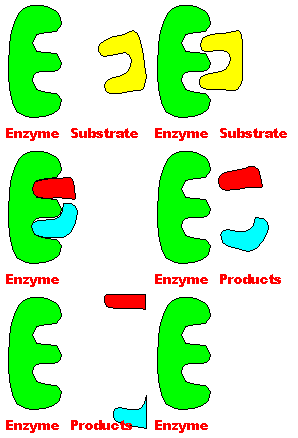
image from: http://www.biologie.uni-hamburg.de/b-online/library/cat-removed/enzyme_.gif
Turkey animation: http://www.myspaceanimations.com/myspace-animations-thanksgiving-turkeys.html
http://www.quia.com/pages/abeapbio.html
Reading Guide ?'s
Modified from Lynn Miriello
Photosynthesis
Respiration
http://www.biologycorner.com/bio3/links.php
2012
| MONDAY 11/28 | TUESDAY 11/29 | WEDNESDAY 11/30 | THURSDAY 12/1 | FRIDAY 12/2 |
|
Review ?'s due Card review Check answers simulation from Concord Consortium's Molecular Workbench |
TEST Chap 14 & 15 HW: 1. Chap 8 ?'s DUE tomorrow "Read for understanding" Chapter 8, 9, 10 REVIEW your "BIO" brain for Chap 9 & 10 |
In class group essay HW: 1. Grade 3 essays due tomorrow Chap 8 ?'s DUE tomorrow 2. Biology Place Lab Bench View Lab 2 tutorial and activities 3.Work on prelab ?'s |
3
graded essay ?'s due 1. Chap 8 ?'s DUE tomorrow 2. Biology Place Lab Bench View Lab 2 tutorial and activities 3.Work on prelab ?'s due Tues |
1 Hour Late start Finish slide show Chapter 8 ?'s due Biology Place Lab Bench 1. View Lab 2 tutorial and activities 2.Work on prelab ?'s due Tues |
| MONDAY 12/5 | TUESDAY 12/6 | WEDNESDAY 12/7 | THURSDAY 12/8 | FRIDAY 12/9 |
|
Be an enzyme
activity
HW: |
Pre lab ?'s due |
Lab2
HW: |
Test corrections
due by end of school today
Be an enzyme ?'s
due Lab 2 follow up
HW: |
Light reactions notes Calvin cycle |
| MONDAY 12/12 | TUESDAY 12/13 | WEDNESDAY 12/14 | THURSDAY 12/15 | FRIDAY 12/16 |
|
Finish cyclic photophosphorylation 12/11/2011 Death of Lynn Margulis HW: Lab 2 ?'s & graph due THURS Read for "understanding"Chapter 9-Respiration Ch 9 ?'s due THURS |
Opener Draw it- Finish Drawing Photosynthesis theater
HW: |
Opener C4 & CAM photosynthesis comparison Photosynthesis on hot/dry days Photosynthesis Venn HW: Photosynthesis Venn due tomorrow |
Comparison
due
Opener |
Lab 2 ?'s and
graphs TEST- CHAPTERS 8 Enzymes only Test results HW: Read for understanding Chap 9 |
| MONDAY 12/19 | TUESDAY 12/20 | WEDNESDAY 12/21 | THURSDAY 12/22 | FRIDAY 12/23 |
|
Respiration Watch Bozeman video Slide show notes |
Short Schedule-Early OUT Finish slide show Draw respiration HW: Respiration ?'s due Wed 1/4 Mito/Chloroplast Venn due Wed 1/4 |
VACATION![]() |
||
| MONDAY 12/24 | TUESDAY 12/25 | WEDNESDAY 12/26 | THURSDAY 12/27 | FRIDAY 12/28 |
|
HAPPY HOLIDAYS |
![]() |
![]() |
|
|
| MONDAY 1/2 | TUESDAY 1/3 | WEDNESDAY 1/4 | THURSDAY 1/5 | FRIDAY 1/6 |
|
|
Welcome back! Finish drawing respiration HW: Study for test FRI |
Mitochondria/Chloroplast Venn DUE Cell Respiration ?'s DUE Card Review ANSWERS HW: Study for test FRI Go to Lab Bench and preview Labs 5 & 6 Test corrections due by end of day FRI |
Opener Card review with answers Answersheet I gave in class had some errors! This is the corrected one! HW: Study for test FRI Go to Lab Bench and preview Labs 5 & 6 Test corrections due by end of day FRI WIKI EXTRA CREDIT due by WED 1/18 |
Enzyme Test corrections due by END OF DAY
today TEST-Chap 9&10 Respiration & Photosynthesis Test results HW: TO DO LIST WIKI EXTRA CREDIT due by WED 1/18 |
| MONDAY 1/9 | TUESDAY 1/10 | WEDNESDAY 1/11 | THURSDAY 1/12 | FRIDAY 1/13 |
AP BIO LAB DAY AP LAB 6DNA Gel Electrophoresis Bacterial Transformation- AP Lab 5-Respiration
We
are the World (watch this before the PCR song)
HW: Lab 6 due WED 1/24 Lab 5 due Chap 17 ?'s due FRI |
LAB DAY Wrap up Check pGLO transformation plates Measure DNA gel Graph DNA standard and determine fragment sizes INVESTIGATION: How can Gel ELectrophoresis be Used to Analyze DNA? on Campbell website |
Ch 16-DNA
|
Build a DNA activity by Kim Foglia REPLICATION Desktop Replication |
Chapter 20-Bacterial genes, plasmids Palindrome OpenerChap 16 reading guide due OpenerPCR PCR DNA gel electrophoresis
Who Ate the Cheese?
Activity |
2011
| MONDAY 11/28 | TUESDAY 11/29 | WEDNESDAY 11/30 | THURSDAY 12/1 | FRIDAY 12/2 |
|
Review ?'s due Card review Check answers simulation from Concord Consortium's Molecular Workbench |
TEST Chap 14 & 15 HW: 1. Chap 8 ?'s DUE tomorrow "Read for understanding" Chapter 8, 9, 10 REVIEW your "BIO" brain for Chap 9 & 10 |
In class group essay HW: 1. Grade 3 essays due tomorrow Chap 8 ?'s DUE tomorrow 2. Biology Place Lab Bench View Lab 2 tutorial and activities 3.Work on prelab ?'s |
3
graded essay ?'s due 1. Chap 8 ?'s DUE tomorrow 2. Biology Place Lab Bench View Lab 2 tutorial and activities 3.Work on prelab ?'s due Tues |
1 Hour Late start Finish slide show Chapter 8 ?'s due Biology Place Lab Bench 1. View Lab 2 tutorial and activities 2.Work on prelab ?'s due Tues |
| MONDAY 12/5 | TUESDAY 12/6 | WEDNESDAY 12/7 | THURSDAY 12/8 | FRIDAY 12/9 |
|
Be an enzyme
activity
HW: |
Pre lab ?'s due |
Lab2
HW: |
Test corrections
due by end of school today
Be an enzyme ?'s
due Lab 2 follow up
HW: |
Light reactions notes Calvin cycle |
| MONDAY 12/12 | TUESDAY 12/13 | WEDNESDAY 12/14 | THURSDAY 12/15 | FRIDAY 12/16 |
|
Finish cyclic photophosphorylation 12/11/2011 Death of Lynn Margulis HW: Lab 2 ?'s & graph due THURS Read for "understanding"Chapter 9-Respiration Ch 9 ?'s due THURS |
Opener Draw it- Finish Drawing Photosynthesis theater
HW: |
Opener C4 & CAM photosynthesis comparison Photosynthesis on hot/dry days Photosynthesis Venn HW: Photosynthesis Venn due tomorrow |
Comparison
due
Opener |
Lab 2 ?'s and
graphs TEST- CHAPTERS 8 Enzymes only Test results HW: Read for understanding Chap 9 |
| MONDAY 12/19 | TUESDAY 12/20 | WEDNESDAY 12/21 | THURSDAY 12/22 | FRIDAY 12/23 |
|
Respiration Watch Bozeman video Slide show notes |
Short Schedule-Early OUT Finish slide show Draw respiration HW: Respiration ?'s due Wed 1/4 Mito/Chloroplast Venn due Wed 1/4 |
VACATION![]() |
||
| MONDAY 12/24 | TUESDAY 12/25 | WEDNESDAY 12/26 | THURSDAY 12/27 | FRIDAY 12/28 |
|
HAPPY HOLIDAYS |
![]() |
![]() |
|
|
| MONDAY 1/2 | TUESDAY 1/3 | WEDNESDAY 1/4 | THURSDAY 1/5 | FRIDAY 1/6 |
|
|
Welcome back! Finish drawing respiration HW: Study for test FRI |
Mitochondria/Chloroplast Venn DUE Cell Respiration ?'s DUE Card Review ANSWERS HW: Study for test FRI Go to Lab Bench and preview Labs 5 & 6 Test corrections due by end of day FRI |
Opener Card review with answers Answersheet I gave in class had some errors! This is the corrected one! HW: Study for test FRI Go to Lab Bench and preview Labs 5 & 6 Test corrections due by end of day FRI WIKI EXTRA CREDIT due by WED 1/18 |
Enzyme Test corrections due by END OF DAY
today TEST-Chap 9&10 Respiration & Photosynthesis Test results HW: TO DO LIST WIKI EXTRA CREDIT due by WED 1/18 |
| MONDAY 1/9 | TUESDAY 1/10 | WEDNESDAY 1/11 | THURSDAY 1/12 | FRIDAY 1/13 |
AP BIO LAB DAY AP LAB 6DNA Gel Electrophoresis Bacterial Transformation- AP Lab 5-Respiration
We
are the World (watch this before the PCR song)
HW: Lab 6 due WED 1/24 Lab 5 due Chap 17 ?'s due FRI |
LAB DAY Wrap up Check pGLO transformation plates Measure DNA gel Graph DNA standard and determine fragment sizes INVESTIGATION: How can Gel ELectrophoresis be Used to Analyze DNA? on Campbell website |
Ch 16-DNA
|
Build a DNA activity by Kim Foglia REPLICATION Desktop Replication |
Chapter 20-Bacterial genes, plasmids Palindrome OpenerChap 16 reading guide due OpenerPCR PCR DNA gel electrophoresis
Who Ate the Cheese?
Activity |
2010
| MONDAY 1/3 | TUESDAY 1/4 | WEDNESDAY 1/5 | THURSDAY 1/6 | FRIDAY 1/7 |
|
NO SCHOOL |
NO SCHOOL |
NO SCHOOL
HW: |
What's up
with ...
LINUS PAULING? 1. Chap 8 Reading guide DUE tomorrow 2. Biology Place Lab Bench View Lab 2 tutorial and activities 3.Work on prelab ?'s 4.Diagrams for All of Lab 2 due MONDAY July 20, 1822- Jan 6, 1884 Gregor Mendel |
Ch 8 reading guide DUE
HW: |
| MONDAY 1/10 | TUESDAY 1/11 | WEDNESDAY 1/12 | THURSDAY 1/13 | FRIDAY 1/14 |
![]() 2 Hour Late start Age reversal in mice Colbert video Lab 2D Prelab ?'s Flow chart for 2A,B,C,D due Be an enzyme
activity HW: |
LAB 2: A, B, C |
LAB
2D class data HW: |
Milk/Eggs/Enzyme
?'s due Lab 2 follow up HW:
|
Be an enzyme ?'s
Draw Photosynthesis Calvin cycle Virtual Cell Photosynthesis movie Cyclic and Noncyclic Photophosphorylation Photosynthetic Electron Transport and ATP Synthesis Photosynthesis on hot/dry days
|
| MONDAY 1/17 | TUESDAY 1/18 | WEDNESDAY 1/19 | THURSDAY 1/20 | FRIDAY 1/21 |
|
NO SCHOOL |
Draw
it- Finish Drawing C4 & CAM photosynthesis comparison HW: Lab 2 ?'s & graph due THURS Read for "understanding"Chapter 9-Respiration Ch 9 ?'s due THURS |
Photosynthesis theater Finish cyclic photophosphorylation Respiration HW: |
Photosynthesis
?'s due Lab 2 ?'s and
graphs HW: Venn diagram TAKE HOME ESSAYS (Do both) due TUES |
Comparison
due
Discuss Venn answers |
| MONDAY 1/24 | TUESDAY 1/25 | WEDNESDAY 1/26 | THURSDAY 1/27 | FRIDAY 1/28 |
|
EXTRA CREDIT reading guides 9 & 10 DUE
Revisit Lab
5-Respiration |
2 Take home essays (Do
both) due TEST- CHAPTERS 8, 9, & 10 Test results HW: "Read for understanding" Ch 22 |
|
||
| MONDAY 1/31 | TUESDAY 2/1 | WEDNESDAY 2/2 | THURSDAY 2/3 | FRIDAY 2/4 |
|
|
2009
| MONDAY 10/19 | TUESDAY 10/20 | WEDNESDAY 10/21 | THURSDAY 10/22 | FRIDAY 10/23 |
| Turn
in your lab book
TEST Chapters 12 & 13 HW: |
Chapter 8
|
TAKE
HOME ESSAY ? DUE Be an enzyme |
NO SCHOOL Conferences 7
am-4 pm |
National
Mole Day Foundation
NO SCHOOL
|
| MONDAY 10/26 | TUESDAY 10/27 | WEDNESDAY 10/28 | THURSDAY 10/29 | FRIDAY 10/30 |
|
Milk/Eggs/Enzyme ?'s due Cyclic and Noncyclic Photophosphorylation Photosynthetic Electron Transport and ATP Synthesis Photosynthesis
on hot/dry days |
Light reactions notes |
Calvin cycle |
TEST
CORRECTIONS DUE SUB HERE I will be gone for NSTA meeting
Biology
Place Lab Bench |
SUB
HERE I will be gone for NSTA meeting Work on your TO DO LIST
|
| MONDAY 11/2 | TUESDAY 11/3 | WEDNESDAY 11/4 | THURSDAY 11/5 | FRIDAY 11/6 |
| Lab
2D Prelab ?'s Flow chart for 2A,B,C,D due Draw Photosynthesis HW: Photosynthesis ?'s due tomorrow |
Photosynthesis
?'s due LAB 2: A, B, C HW: Start lab ?'s |
Finish
Drawing
Clickers! |
LAB
2D
HW: Lab ?'s and
graphs |
Calendar
DUE-Get this in so we can plan our "field trip"
Check your fruitflies C4 & CAM
photosynthesis comparison |
| MONDAY 11/9 | TUESDAY 11/10 | WEDNESDAY 11/11 | THURSDAY 11/12 | FRIDAY 11/13 |
| Cellular
Respiration
Krebs
cycle animation
HW: LAB 2 ?'s & Graphs due THURS |
Draw
it- Cellular Respiration HW: LAB 2 ?'s & Graphs due THURS Ch 9 ?'s due tomorrow Study for Chapter test MON |
Ch 9 ?'s due Lab 4A-Pigment chromatography Look at stomata Mitochondria/Chloroplast comparison
HW: Finish comparison LAB 2 ?'s & Graphs due THURS |
Comparison
due
Lab2 ?'s and
graphs HW: Study for Chapter test MON |
REVIEW Too many gone for absorption spectrum lab Clicker
game ?'s |
| MONDAY 11/16 | TUESDAY 11/17 | WEDNESDAY 11/18 | THURSDAY 11/19 | FRIDAY 11/20 |
| TEST- CHAPTERS 8, 9, & 10 Clear vials/Collect males |
1st
Q INCOMPLETES DUE MIDTERM GRADES |
Take home essays due | ||
| MONDAY 11/23 | TUESDAY 11/24 | WEDNESDAY 11/25 | THURSDAY 11/26 | FRIDAY 11/27 |
| NO SCHOOL
|
NO SCHOOL Thanksgiving Break |
2007
| MONDAY 10/22 | TUESDAY 10/23 | WEDNESDAY 10/24 | THURSDAY 10/25 | FRIDAY 10/26 |
| Essay
?'s due
Turn in
Labbooks Start Chap 8 HW: Metabolism/Vocab |
National
Mole Day Foundation
HW: TEST
Corrections due TOMORROW |
TEST
CORRECTIONS DUE
Finish Toothpickase Lab Fun
with Milk and Eggs Lab |
Chapter
8 ?'s due
Toothpickase
Lab due |
|
| MONDAY 10/29 | TUESDAY 10/30 | WEDNESDAY 10/31 | THURSDAY 11/1 | FRIDAY 11/2 |
| Finish
Light Reactions Group ? time to work on Photosynthesis ?'s HW: Photosynthesis ?'s due MON |
Calvin
Cycle
HW: Parent Teacher Conferences 4-7:30 |
Graded
Practice ?'s due Discuss practice ?/grading Computer Lab-Pre-lab
#4 Parent Teacher Conferences 4-6:30 |
NO
SCHOOL
Parent Teacher
Conferences |
NO SCHOOL |
| MONDAY 11/5 | TUESDAY 11/6 | WEDNESDAY 11/7 | THURSDAY 11/8 | FRIDAY 11/9 |
| Photosynthesis
?'s due
Pre
Lab #4 DUE |
LAB #4B | Lab #4B
HW: Finish Lab 4 ?'s and graphs |
LAB
4 RESULTS Draw Photosynthesis HW: Lab 4 due
tomorrow |
LAB 4 DUE |
| MONDAY 11/12 | TUESDAY 11/13 | WEDNESDAY 11/14 | THURSDAY 11/15 | FRIDAY 11/16 |
| Respiration
See why cells use cellular respiration Respiration |
Before
school help session @ 7:45 Prelab 5 due Respiration |
Before
school help session @7:45 Chap
9 ?'s due
Lab 4
|
Before
school help session @ 7:45 Finish lab 5 Difference/Corrected
values |
Before
school help session @ 7:45
TEST |
| MONDAY 11/19 | TUESDAY 11/20 | WEDNESDAY 11/21 | THURSDAY 11/22 | FRIDAY 11/23 |
| Essay
?'s due TEST- Multiple choice portion HW: Meiosis Chap ?'s due TUES |
LAB
5 due
Desktop Meiosis HW: Make test
corrections due MONDAY |
NO SCHOOL
|
NO SCHOOL Thanksgiving Break |
|
| MONDAY 10/22 | TUESDAY 10/23 | WEDNESDAY 10/24 | THURSDAY 10/25 | FRIDAY 10/26 |
| Essay
?'s due
Turn in
Labbooks Start Chap 8 HW: Metabolism/Vocab |
HW: TEST
Corrections due TOMORROW |
|
Chapter
8 ?'s due
Toothpickase
Lab due |
|
| MONDAY 10/29 | TUESDAY 10/30 | WEDNESDAY 10/31 | THURSDAY 11/1 | FRIDAY 11/2 |
| Finish
Light Reactions Group ? time to work on Photosynthesis ?'s HW: Photosynthesis ?'s due MON |
Calvin
Cycle
HW: Parent Teacher Conferences 4-7:30 |
Graded
Practice ?'s due Discuss practice ?/grading Computer Lab-Pre-lab
#4 Parent Teacher Conferences 4-6:30 |
NO
SCHOOL
Parent Teacher
Conferences |
NO SCHOOL |
| MONDAY 11/5 | TUESDAY 11/6 | WEDNESDAY 11/7 | THURSDAY 11/8 | FRIDAY 11/9 |
| Photosynthesis
?'s due
Pre
Lab #4 DUE |
LAB #4B | Lab
#4B
HW: Finish Lab 4 ?'s and graphs |
LAB
4 RESULTS Draw Photosynthesis HW: Lab 4 due
tomorrow |
LAB 4 DUE |
| MONDAY 11/12 | TUESDAY 11/13 | WEDNESDAY 11/14 | THURSDAY 11/15 | FRIDAY 11/16 |
| Respiration
See why cells use cellular respiration Respiration |
Before
school help session @ 7:45 Prelab 5 due Respiration |
Before
school help session @7:45 Chap
9 ?'s due
Lab 4
|
Before
school help session @ 7:45 Finish lab 5 Difference/Corrected
values |
Before
school help session @ 7:45
TEST |
| MONDAY 11/19 | TUESDAY 11/20 | WEDNESDAY 11/21 | THURSDAY 11/22 | FRIDAY 11/23 |
| Essay
?'s due TEST- Multiple choice portion HW: Meiosis Chap ?'s due TUES |
LAB 5 due | |||